
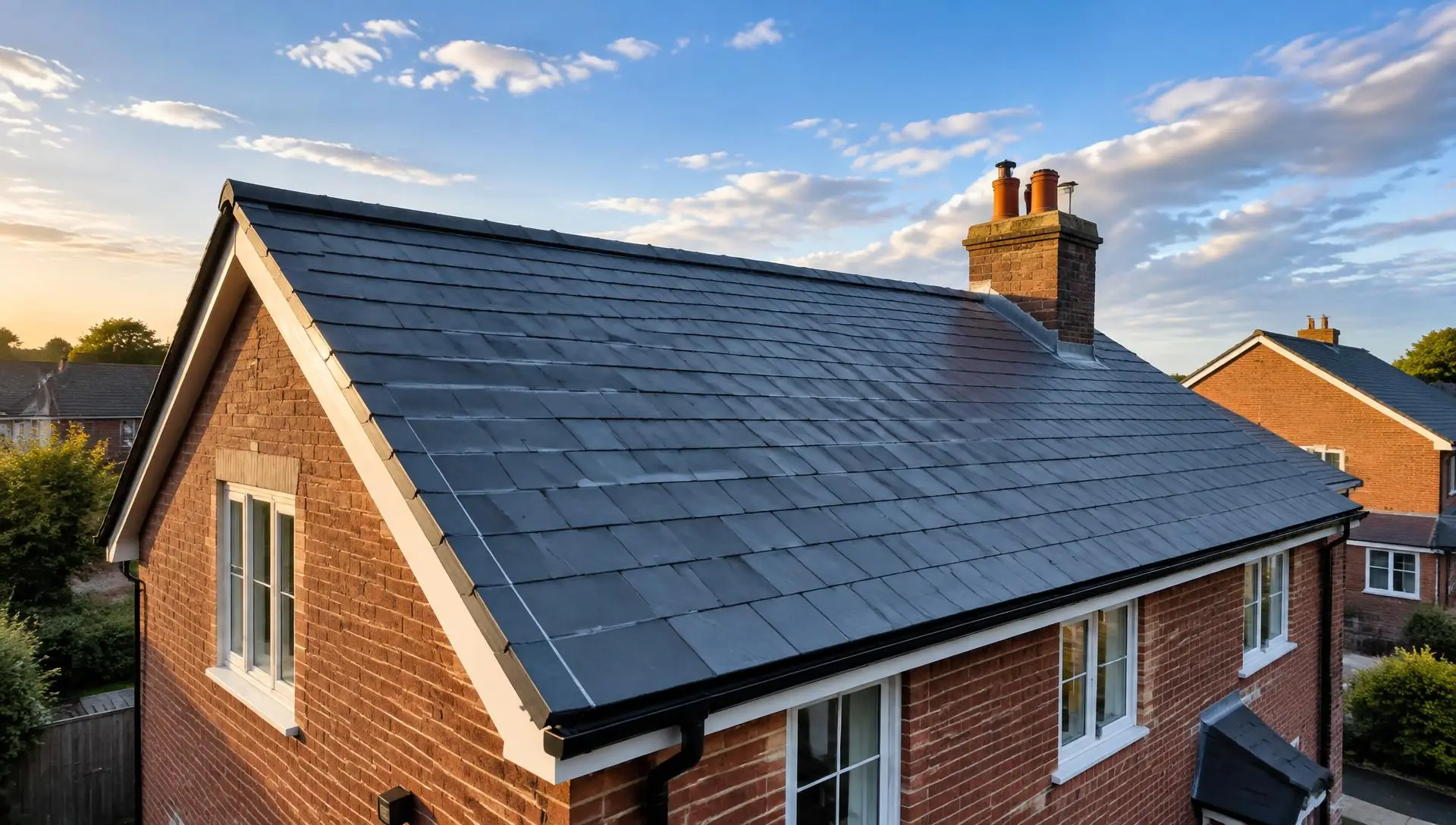
From Old Harlow to the planned neighbourhoods
Old Harlow, Mark Hall, The Stow and Church Langley reflect different stages of the town’s development. Earlier streets and planned residential groups sit alongside newer housing. Terraces, houses with garages and detached homes can present quite different roof layouts. Use these local settings as context, not as proof that every property in one neighbourhood has the same construction.
We cover Harlow as part of our Essex area; ask to check availability. Authentic Building & Roofing Ltd is run by Lee Draper from Witham. The Areas hub sets out the wider Essex and east London outskirts coverage. For the service range rather than the location, see roofing.
Continuous rooflines need a clear boundary
On a terrace, the covering may appear to continue across several houses. Before planning work, establish which section belongs to the property, how it meets the neighbouring roof and whether rainwater components are shared. Changes to one section should be considered in relation to adjoining materials rather than treated as an isolated rectangle.
A junction at a party wall, differing tile levels or a previous alteration can influence the repair method. Tell Lee about shared access and neighbouring structures when discussing a visit. Permission, ownership and any separate neighbour-related requirements need checking where applicable; this information does not decide those matters for a particular address.
A flat roof needs an understanding of the build-up
Garages, porches and low additions may have flat coverings even where the main house roof is pitched. The surface is only one layer of the construction. The deck beneath, insulation arrangement, wall junction and outlet all affect performance. A split in the covering may be a local fault or a sign that the support beneath has moved.
Our flat roofing information discusses GRP fibreglass and EPDM rubber. Ask how a proposed system would connect to the existing building and dispose of rainfall. Choosing a membrane alone does not resolve a sagging deck, blocked drainage route or an unsuitable finished level.
Checking pitched coverings and roof edges
Concrete or clay tiles can be damaged individually, while deterioration in fixings or support may affect a broader area. Moss, a slipped tile or a weathered surface is a reason to investigate, not enough on its own to decide that the complete roof needs replacement. The remaining covering and underlying construction should guide the next step.
Read new roofs when considering renewal, or roof repairs for individual faults and junction problems. A proposal should explain why one route is suitable and identify what can be checked before materials are lifted. Ask how further discoveries would be discussed if concealed layers cannot be inspected initially.
Eaves, ventilation and shared rainwater routes
Soffits close the underside of the eaves, while fascias support the gutter line. Their condition needs considering alongside the roof edge and the ventilation strategy for the roof space. A dripping outlet does not prove that the boards need changing; rotten supports are a different problem from a local gutter joint.
For the component-by-component picture, use fascias, soffits and guttering. In a group of attached homes, clarify where water drains and who is responsible for each section. Keeping those details clear avoids confusing a fault at one outlet with a complete roofline replacement.
Ask about a Harlow assessment
Use the quote enquiry form to send the Harlow postcode and the roof concern or planned change. Include whether the house is attached, whether an addition sits below the work area and any access restrictions. Pictures already taken from a safe place can help describe the situation.
A free site visit and written quote can be discussed with Lee, subject to confirming availability for the proposed work. No previous Harlow job is implied by this page, and it does not promise an arrival time. Start with the property details so the appropriate next step can be agreed directly.