
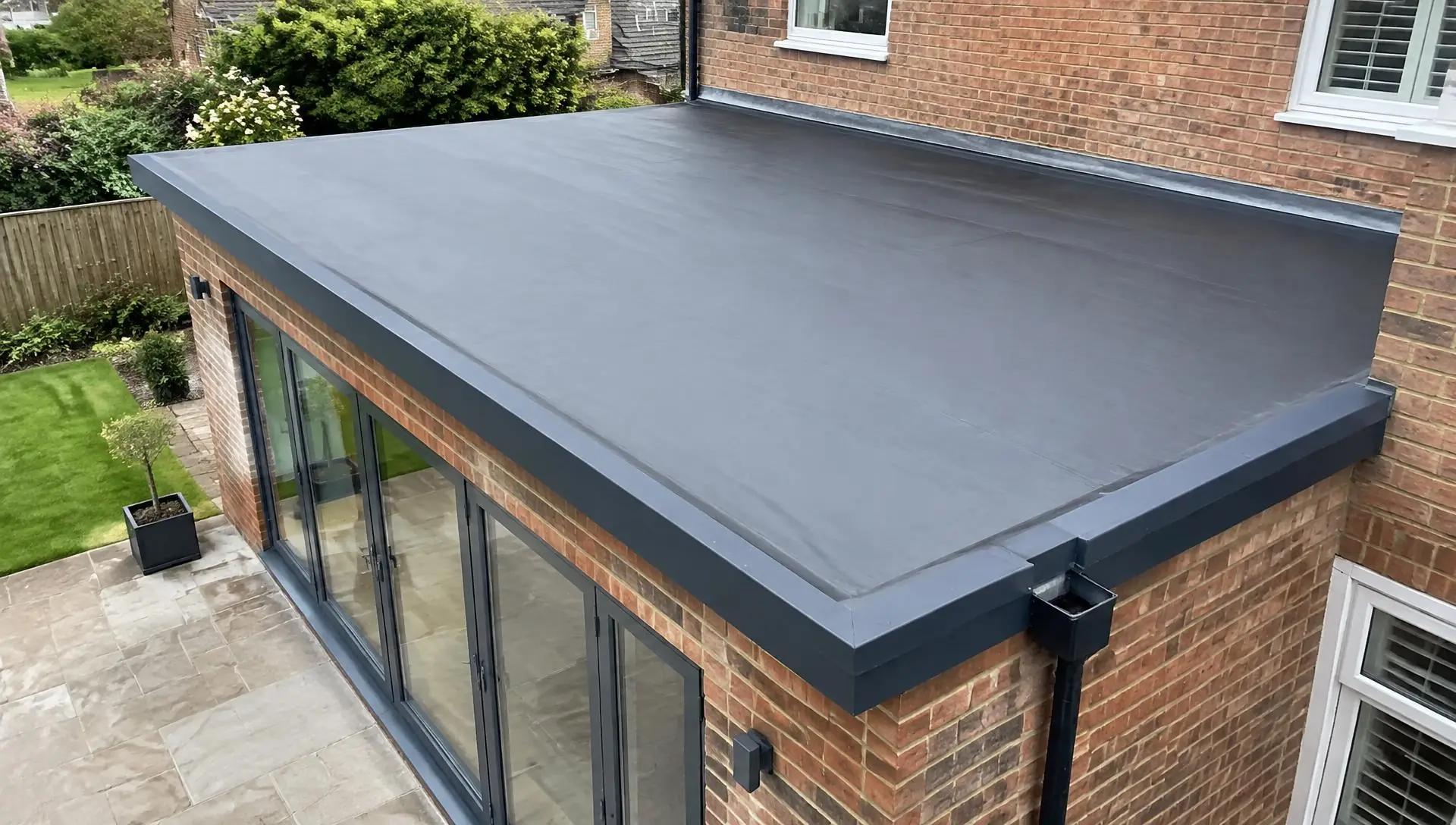
What GRP is and how it goes on
GRP stands for glass reinforced plastic, better known as fibreglass. The roofer bonds a mat of glass fibre to a new deck using liquid resin, rolls it out to remove air, then finishes it with a coloured topcoat. Once it cures it becomes one hard, seamless shell with no joins at all.
Edges and upstands are formed with preformed trims that are glassed in, so the drip edge, wall junctions and gutter detail all become part of the same skin. It is a craft job: the mix, the temperature and the thickness of resin all have to be right.
What EPDM is and how it goes on
EPDM is a synthetic rubber membrane. On most domestic roofs it arrives as one sheet cut to size, so there are no seams across the main area. It is bonded to the deck with adhesive, then trimmed and fixed at the edges with purpose-made trims. Corners and upstands are folded or formed with special pieces and sealed.
Because the sheet is flexible, it copes well with a small amount of movement in the building, such as a timber extension settling over the seasons.
Looks, joins and detailing
A finished GRP roof has a smooth, slightly glossy surface and comes in a few colours, with crisp edge trims. EPDM has a matt black rubber look and a softer edge line. From the garden, most people cannot see either, but on a balcony or a roof overlooked by upstairs windows the finish can matter.
Roofs with lots of corners, roof lights and pipes tend to suit GRP, because every awkward detail can be built up in resin. Large plain rectangles suit EPDM, where one sheet covers the lot quickly.
Foot traffic, balconies and upkeep
GRP is rigid and hard-wearing, so it handles occasional foot traffic and can be used where you step out onto a roof. EPDM will take careful foot traffic for maintenance, but sharp objects and dragged furniture can mark it, so it is better on roofs nobody uses. Either way, keep outlets and gutters clear of leaves.
Weather on the day
GRP resin needs dry conditions and a sensible temperature to cure properly. Damp or cold days can delay the job. EPDM adhesives also need a dry deck, but the system as a whole is a little more forgiving of cooler weather. We plan installs around the forecast for both.
Repairs if something goes wrong
Damage to a GRP roof is repaired by grinding back the area and laying new mat and resin over it, blended in with topcoat. EPDM is repaired with a patch of membrane bonded over the hole. Both are straightforward for a roofer who knows the system; the key is not to let water sit under the surface for long. If yours is already letting water in, see our page on a leaking flat roof.
Which suits garages, extensions and dormers?
There is no single winner, and we lay both. As a loose guide, a simple detached garage roof is often a good fit for EPDM. A rear extension with roof lights, a parapet or a step-out area often suits GRP. Dormer tops are small but fiddly, and either can work depending on the edge details.
Lee Draper will walk you through both on a free visit and explain why he recommends one for your roof. Read more about how we lay them on our flat roofing page, or see what affects the price in the flat roof replacement cost guide.
What about the deck and insulation?
Whichever covering you choose, it is only as good as what lies beneath. Both GRP and EPDM need a dry, firm, smooth deck, usually new boards fixed over the joists. Where an old deck has gone soft, it is replaced before anything else happens. If the roof sits over a heated room, the job may also be an opportunity, or a requirement, to add insulation boards in a warm roof build-up. Our guide to planning and building regulations touches on when that applies.
Choosing between the two systems is a smaller decision than getting the base right. A well-prepared roof with either covering will serve you far better than a rushed job with the more expensive one.